

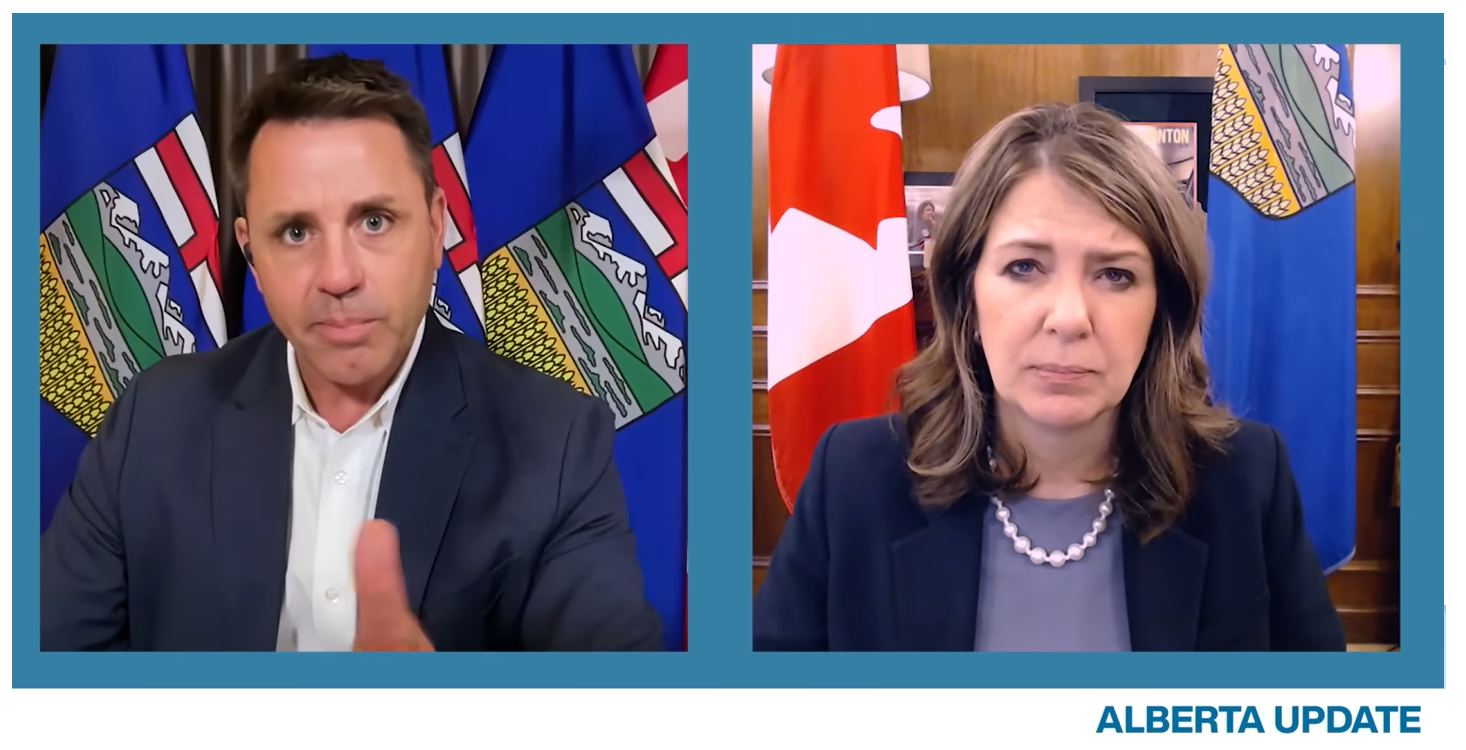
Alberta Premier Danielle Smith used her year-end interview with Bruce McAllister on Alberta Update to argue that Alberta’s economic direction shifted in 2025.
Smith said recent federal-provincial agreements on energy gave companies more certainty to plan long-term investments. She linked renewed interest in pipeline capacity, natural gas power generation, and industrial projects to the removal of federal policies that, in her view, made large projects too risky to pursue. According to Smith, companies are now willing to expand because they no longer expect sudden rule changes.
Trade and market access were a central focus of the discussion. Smith emphasized that expanding access to overseas markets would strengthen Alberta’s economy. She pointed to Pacific export routes as a practical way to reach Asian markets more efficiently.
Health care reform was presented as one of the government’s most significant undertakings of the year. Smith said the previous structure lacked clear accountability and made it difficult to measure results. By separating who pays for services, who delivers them, and who evaluates performance, she said the province expects better oversight. She also pointed to an increase in doctors and nurse practitioners taking new patients, linking that to changes in how primary care is funded.
Education pressures were discussed mainly in terms of rapid enrolment growth. Smith said population increases placed strain on classrooms, particularly where language support and behavioural needs are high. She said the government is focusing on targeted supports rather than broad funding changes, arguing that not all schools face the same challenges.
On Alberta’s relationship with Ottawa, Smith acknowledged that frustration with federal policies has grown among Albertans. She said her government does not support breaking up the country but believes provinces must push back when federal decisions affect areas of provincial responsibility. According to Smith, Alberta intends to use every legal and constitutional tool available to protect its interests.
Looking ahead, much will depend on how effectively the Alberta and federal governments cooperate in 2026 and whether recent agreements yield tangible outcomes. What is already clear is that Canadians are feeling sustained economic pressure in their daily lives, from housing to food to public services. Simply enduring is not a solution. The next phase will test whether cooperation and policy follow-through can ease those strains or whether governments leave Canadians to manage on their own.