

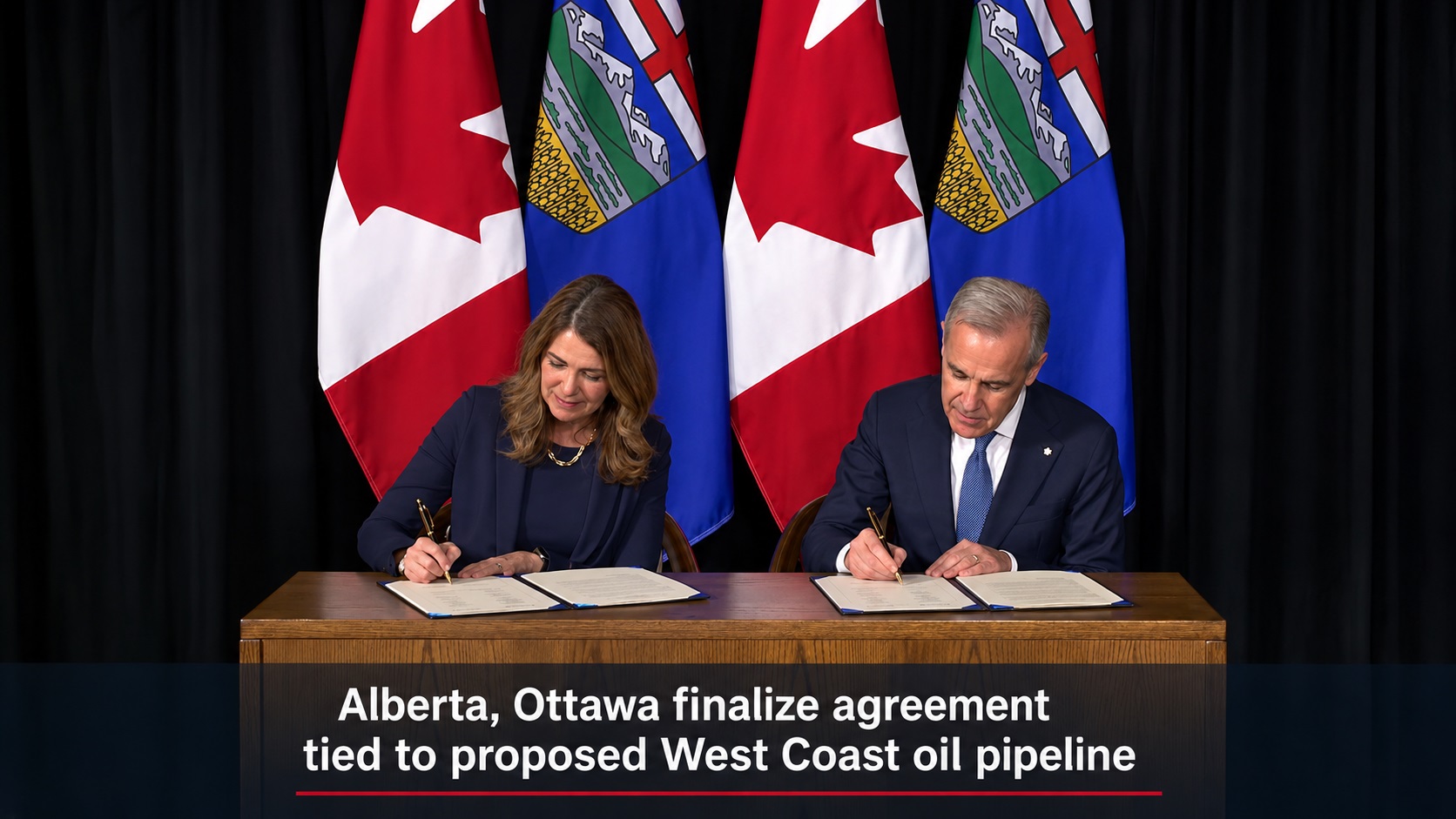
Alberta Premier Danielle Smith and Prime Minister Mark Carney finalized a new agreement today, on May 15, 2026, Thursday aimed at advancing a proposed West Coast oil pipeline and reshaping parts of Canada’s industrial carbon pricing system.
The announcement confirms months of negotiations between Alberta and Ottawa over energy development, emissions policy and major project approvals.
Under the agreement, Alberta plans to move ahead with a proposed pipeline capable of transporting more than one million barrels of oil per day to Asian markets, with construction potentially beginning as early as Sept. 1, 2027.
The deal also includes changes to environmental and regulatory policies that both governments say are meant to reduce uncertainty for investors and speed up approvals for major energy projects.
One of the biggest changes involves industrial carbon pricing.
Smith said Alberta avoided what would have been a federally mandated increase to $170 per tonne by 2030. Instead, the revised framework would keep the industrial carbon price at $95 per tonne for the rest of this year, rise to $100 for the next three years and gradually increase to $130 by 2035.
She said the changes could save industry roughly $250 billion in compliance costs by 2050 while giving companies more certainty to invest in emissions reduction projects.
Carney said the agreement is designed to strengthen investor confidence and position Canada as a stable long-term energy supplier.
Alberta committed to submitting a formal pipeline proposal to the federal major projects office by July 1, while Ottawa pledged to consider designating it a “project of national interest” by Oct. 1 under the federal Building Canada Act.
The agreement also includes commitments related to methane reductions, renewable energy, electricity development and carbon capture infrastructure.
The federal government says methane emissions from the oil and gas sector would be reduced 75 percent below 2014 levels by 2035 under the proposed framework.
Ottawa and Alberta also agreed to jointly support carbon capture and clean energy projects through 75 million tonnes worth of carbon contracts for difference, with costs shared equally between the two governments.
The agreement marks a significant shift after years of tensions between Alberta and the federal government over emissions caps, environmental reviews and pipeline approvals.
Smith said Ottawa had already agreed to remove or roll back several policies Alberta strongly opposed, including proposed oil and gas emissions caps and clean electricity regulations.
Both leaders also emphasized Indigenous consultation and economic participation as part of future development plans.
The proposed pipeline would still face regulatory reviews, consultations and likely opposition from environmental groups and some communities in British Columbia, where previous pipeline projects have faced years of political and legal battles.